When the Forecast Is Wrong, the Bill Is Real: How Meteorological Miscalculation Is Draining Enterprise Energy Budgets
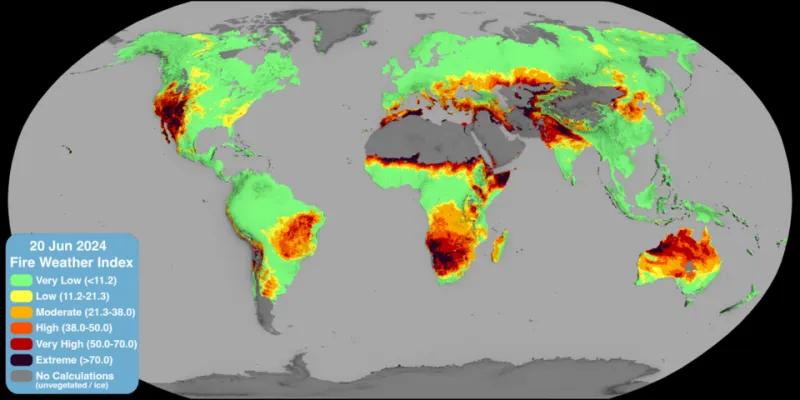
Photo: NASA's Scientific Visualization Studio - USRA/Trent L. Schindler, Columbia University/Robert Field, Public domain, via Wikimedia Commons
There is a quiet assumption embedded in nearly every enterprise energy procurement strategy: that weather forecasts are reliable enough to anchor long-term financial commitments. For decades, that assumption was defensible. Seasonal patterns were predictable. Demand curves followed familiar trajectories. Procurement teams could model heating and cooling loads with reasonable confidence, lock in supply contracts accordingly, and move on.
That assumption is no longer safe.
As climate volatility accelerates, the gap between forecast and reality has widened in ways that translate directly into financial exposure. Enterprises that built procurement strategies around historical meteorological averages are discovering—sometimes during settlement—that the models they trusted were calibrated for a climate that no longer exists.
The Mechanics of Meteorological Mispricing
Energy pricing and weather forecasting are more tightly coupled than most enterprise buyers appreciate. Wholesale power markets price electricity in real time based on anticipated demand, and demand is, at its core, a weather-driven phenomenon. When temperatures deviate from forecast—whether by two degrees or twelve—load projections shift, dispatch schedules change, and spot prices move accordingly.
For an enterprise holding a fixed-price contract anchored to a demand forecast that proves inaccurate, the consequences are immediate. If actual consumption exceeds contracted volumes during a heat event that forecasters underestimated, the company must purchase excess power at elevated spot prices. If consumption falls short during a milder-than-expected winter, the enterprise is paying for capacity it never used—a dynamic explored extensively in prior analyses of contract overhang.
What makes this particularly costly at scale is the compounding effect across large, geographically distributed operations. A single facility absorbing a weather-driven pricing error is a manageable problem. A portfolio of fifty facilities absorbing simultaneous errors across multiple regional markets is a material financial event.
Climate Volatility Is Outrunning the Models
The core issue is not that meteorologists are performing poorly. The issue is that the statistical frameworks underlying most commercial energy forecasting tools were built on historical climate data that no longer adequately represents present conditions.
The United States has experienced a measurable increase in the frequency and intensity of extreme weather events over the past two decades. Heat domes, polar vortex intrusions, and atmospheric river events have become more common—and more severe—than historical baselines would predict. The models used by utilities, grid operators, and energy traders to project demand are, in many cases, still weighted toward those older baselines.
The result is a systematic bias in demand forecasting that tends to underestimate peak load during extreme heat events and overestimate load during anomalously warm winters. Both errors carry financial consequences for enterprise buyers, but in different directions and through different mechanisms.
During underestimated peaks, enterprises face real-time price exposure and potential reliability risk. During overestimated demand periods, they are locked into supply commitments that exceed actual consumption, generating stranded costs that erode energy ROI without any corresponding operational benefit.
The Portfolio Amplification Problem
Large enterprises tend to think about weather risk at the facility level. A manufacturing plant in Texas, a data center in Virginia, a distribution hub in Illinois—each carries its own localized weather exposure. What is less commonly modeled is the correlation structure across those exposures.
When a broad weather system affects multiple regions simultaneously—as increasingly common large-scale climate events tend to do—portfolio-level exposure can spike well beyond what individual facility risk models would suggest. The diversification benefit that enterprise energy buyers traditionally relied upon to smooth out regional weather anomalies becomes unreliable precisely when conditions are most extreme.
This is the phantom peak problem in its most financially significant form. The enterprise did not fail to model its facilities. It failed to model the system-level behavior that emerges when forecasting errors cluster across a portfolio simultaneously. The resulting exposure is, in a meaningful sense, invisible until settlement—at which point it is entirely real.
What Leading CFOs Are Doing Differently
The financial leaders most effectively managing this risk are not simply purchasing better weather data, though that is part of the picture. They are fundamentally restructuring their procurement frameworks to reduce dependence on point-in-time forecast accuracy.
Several strategic shifts are emerging among enterprise energy buyers who have absorbed the cost of significant forecasting errors:
Dynamic hedging over static commitment. Rather than locking full supply volumes to a single forecast scenario, sophisticated buyers are constructing layered procurement structures that leave a portion of anticipated demand unhedged—or hedged through options rather than fixed contracts—specifically to preserve flexibility when forecast accuracy degrades.
Ensemble forecasting integration. Rather than relying on a single meteorological model, leading procurement teams are incorporating ensemble forecasting approaches that represent a range of probable weather outcomes and their associated demand implications. This allows procurement decisions to be calibrated to a probability distribution rather than a single point estimate.
Shorter commitment windows with rolling adjustments. Multi-year fixed contracts made sense when climate conditions were stable enough to make long-range demand projections reliable. As that reliability erodes, some CFOs are shifting toward shorter commitment windows—twelve to eighteen months rather than three to five years—combined with systematic rolling adjustments as forecast accuracy improves at shorter time horizons.
Real-time consumption monitoring with automatic rebalancing triggers. Technology investments in advanced metering infrastructure and real-time load management platforms are enabling enterprises to detect demand deviations from forecast early enough to execute market adjustments before settlement exposure becomes significant.
The Governance Dimension
Beyond procurement mechanics, the weather forecasting risk problem has a governance dimension that boards and audit committees are beginning to take seriously. Energy cost is a material line item for most large industrial and commercial enterprises. When that cost is subject to significant unhedged meteorological exposure, it represents a form of financial risk that belongs in enterprise risk management frameworks—not just in the energy procurement function.
The question is not whether weather-driven energy mispricing will occur. Given current climate trajectory, it will. The question is whether the enterprise has structured its procurement approach, its hedging instruments, and its real-time operational responses to limit the financial impact when the forecast proves wrong.
For enterprises still operating on static, forecast-anchored procurement strategies, the exposure is not theoretical. It is accumulating quietly, one settlement period at a time, in the gap between what the model predicted and what the atmosphere delivered.
Building Resilience Into the Procurement Architecture
The energy buyers best positioned for the decade ahead are those treating meteorological uncertainty as a permanent structural feature of their operating environment rather than an occasional exception. That reorientation has practical implications for how contracts are structured, how hedging programs are designed, and how procurement teams are resourced and empowered.
Static strategies built for a stable climate will continue to generate phantom peak exposure—costs that appear without warning, accumulate without visibility, and settle without recourse. Dynamic frameworks built for volatility will not eliminate weather-driven financial risk, but they will transform it from an unmanaged liability into a quantified, hedged, and operationally responsive exposure.
In an environment where the forecast is increasingly likely to be wrong, the enterprises that build resilience into their procurement architecture—rather than assuming the model will hold—are the ones that will protect margin when conditions diverge from expectation. That is not a meteorological challenge. It is a strategic one.